Chevalement 1 bis
RESTORING A MINING HEADFRAME Preserving the mining headframe 1bis in Liévin, a local landmark, begins with safeguarding the structure itself through maintenance and preventive conservation. That involves stripping, repairing and repainting the metal frame with three coats to protect it from corrosion and decay, helping to ensure its long-term survival.
Lucas Monsaingeon, Project director
Les Éclaireurs, Spotlight
TPF ingénierie S.A.S., Comprehensive engineering : Structural, MEP, Thermal, Fire safety coordination, Works coordination, High environmental quality
FL ingénierie, Construction economics consultancy
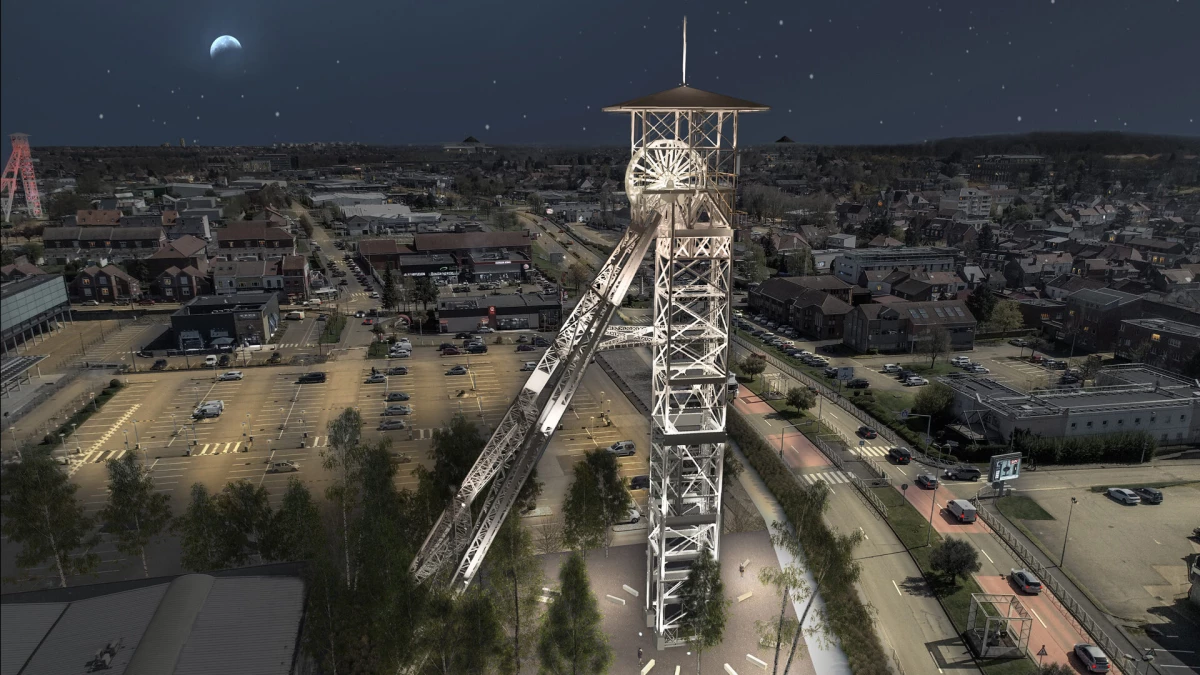
Standing 46 metres tall, the Mining Headframe 1bis in Liévin is an iconic monument to local miners and to the history of coal mining in the region. Preserving it as a landmark involves safeguarding it with preventive conservation measures to protect it from corrosion and disappearance. The colour chosen was a metallic grey which would stand out against a blue sky. The colour was selected for aesthetic, technical and historical reasons, but it was also the most historically accurate choice and the only one that allowed for a varied colour palette when the structure was illuminated at night. The surrounding area was to be made more accessible through a single, gently sloping surface of stabilised black sand and planted with grasses and birch trees, a pioneer species in post-industrial regeneration. Benches arranged in a 360-degree radius around the shaft would point toward other landmarks in the mining basin. Beneath the headframe’s four legs, a polished stainless-steel disc would mark the location of shaft 1bis. Visitors could lean over it and get a sense of vertigo from the 796-metre hole below. The site plan was designed to fit with a broader masterplan linked to a future cycle path and would kickstart improvements to the surrounding boulevard and car parks and reconnect the site with the town centre. This made the project a starting point for further urban and landscape development.
At nightfall, the headframe would be lit up with soft, still white lights. The lighting would shift from bottom to top between two shades of warm white, accentuating the height of the metal structure. Lighting on the pulley wheels would suggest a turning motion. Every 20 minutes a short lighting sequence would play and refreshing how the monument was perceived through pauses, waves of light and shadows that suggested the motion of miners going up and down. Every hour, sparkling lights would mark the passage of time. The lighting would be powered by low-energy LED projectors, providing flexible options for a wide range of programmable effects and colours. Our proposal reaffirmed the heritage site’s living, evolving identity and new ways of using the site. The headframe symbolises the memory of the region’s mining past but also serves as a base for telecommunications antennas, vital digital infrastructure for the region. Embracing and supporting that role facilitates the transition between the first industrial revolution and the third.